

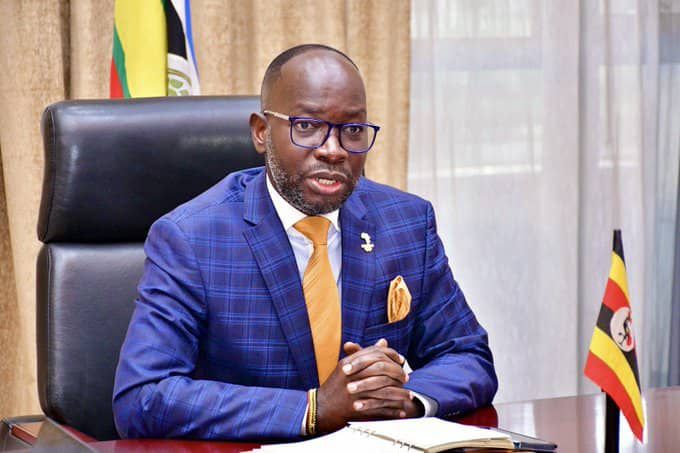
Government Chief Whip Denis Hamson Obua has stated that Cabinet will meet today to conclude the harmonization process of the Protection of Sovereignty Bill, 2026, ahead of its second and third readings in Parliament scheduled for Tuesday.
Speaking during an interview with The Nile Post on Sunday, Obua said Government is in the final stages of harmonizing the Bill following guidance from President Yoweri Museveni and consultations involving Cabinet, the Attorney General, the Ministry of State for Internal Affairs, and parliamentary leadership, while also taking into account public concern.
“I believe all Ugandans have seen the strategic guidance of President Museveni; his letter is full of do’s and don’ts,” he said.
“As Government, guided by our two most senior legal minds the Attorney General and the Minister of State for Internal Affairs, David Muhoozi we have embarked on a process of harmonizing the Bill, as guided by the President, and in consultation with Cabinet, while taking into consideration the wider public outcry within Uganda.”
Obua added that Government is optimistic a revised version of the Bill will be presented to the country “either this week or the next,” stressing that the legislation is intended to put a full stop to “external influence on matters of governance and politics in Uganda as an independent state.”
The Bill has in recent weeks become the subject of intense national debate. President Museveni has since distanced himself from what he described as “misinterpretations” of the proposed law.
In a statement shared on his X (formerly Twitter) account, Museveni questioned whether critics were referring to the version he initiated in Cabinet, stressing that his original proposal was grounded in Uganda’s historical struggle for sovereignty and policy independence.
He clarified that his intention was to safeguard Uganda’s autonomy in decision-making across political, social, cultural, economic, and diplomatic spheres, while firmly rejecting suggestions that the Bill seeks to restrict foreign direct investment, remittances, or religious funding.
Museveni emphasized that Uganda remains a free-market economy, noting that private sector activity is central to national development and that foreign exchange continues to be freely traded through private bureaus. He further stated that legally earned money can move in and out of the country without hindrance.
To ensure alignment with this intent, the President held discussions with Obua and relevant parliamentary committee leadership, directing that the Bill be refined strictly to focus on sovereignty in policymaking while protecting private enterprise.
The draft legislation currently before Parliament, tabled by State Minister for Internal Affairs David Muhoozi, has attracted widespread criticism over its broad regulatory scope.
Among its provisions are enhanced government oversight of digital platforms and civic engagement, mandatory registration and vetting of foreign-funded entities, restrictions on foreign funding without ministerial approval, and strict monthly reporting requirements for financial institutions.
One of the most controversial provisions introduces the offence of “economic sabotage,” broadly defined to include publishing information deemed harmful to economic stability or mobilizing opposition to government policy without prior approval.
Critics argue that these clauses risk undermining freedoms of expression, association, and access to information, while potentially exposing journalists, researchers, and civil society actors to criminal liability.
The Governor of the Bank of Uganda, Michael Atingi-Ego, has also warned that the Bill could have far-reaching economic consequences, including capital flight, weakening of the shilling, and reduced investor confidence.
He cautioned that Uganda’s external financial stability could be affected due to reliance on foreign capital inflows.
In response to mounting concerns, Attorney General Kiryowa Kiwanuka has proposed amendments exempting financial institutions supervised by the Central Bank, as well as medical, educational, and religious institutions, from the scope of the Bill.
Despite these revisions, critics continue to argue that the core regulatory framework remains overly expansive.
Government officials and supporters within the ruling establishment, including the NRM Parliamentary Caucus, have defended the Bill as a necessary safeguard against foreign interference and covert influence operations, noting that similar regulatory frameworks exist in other jurisdictions.
According to parliamentary sources, majority members of the joint committees on Legal and Parliamentary Affairs and Defense and Internal Affairs have agreed to support the Bill adopting revisions proposed by the Attorney General.
The legislators have been meeting since Friday at Munyonyo Commonwealth Resort to compile their report ahead of presentation to Parliament.
Notably, the position has reportedly been backed by some opposition Members of Parliament, including representatives from the Forum for Democratic Change (FDC) and Uganda People’s Congress (UPC), although their identities remain undisclosed.
However, the deliberations have been marked by tension, with reports of chaos and a brief scuffle breaking out after the Committee Chair allegedly pushed for adoption of the Attorney General’s amended draft without a thorough clause-by-clause review of stakeholder submissions.
The Joint Committee is chaired by Wilson Kajwenge and co-chaired by Stephen Baka Mugabi.
The disagreements reportedly prompted heavy deployment of security personnel, who remain stationed at the venue as report writing continues.
One committee member described the proceedings as strained:
“We still had a lot we wanted to change, but even getting a chance to speak became a tug of war.”
